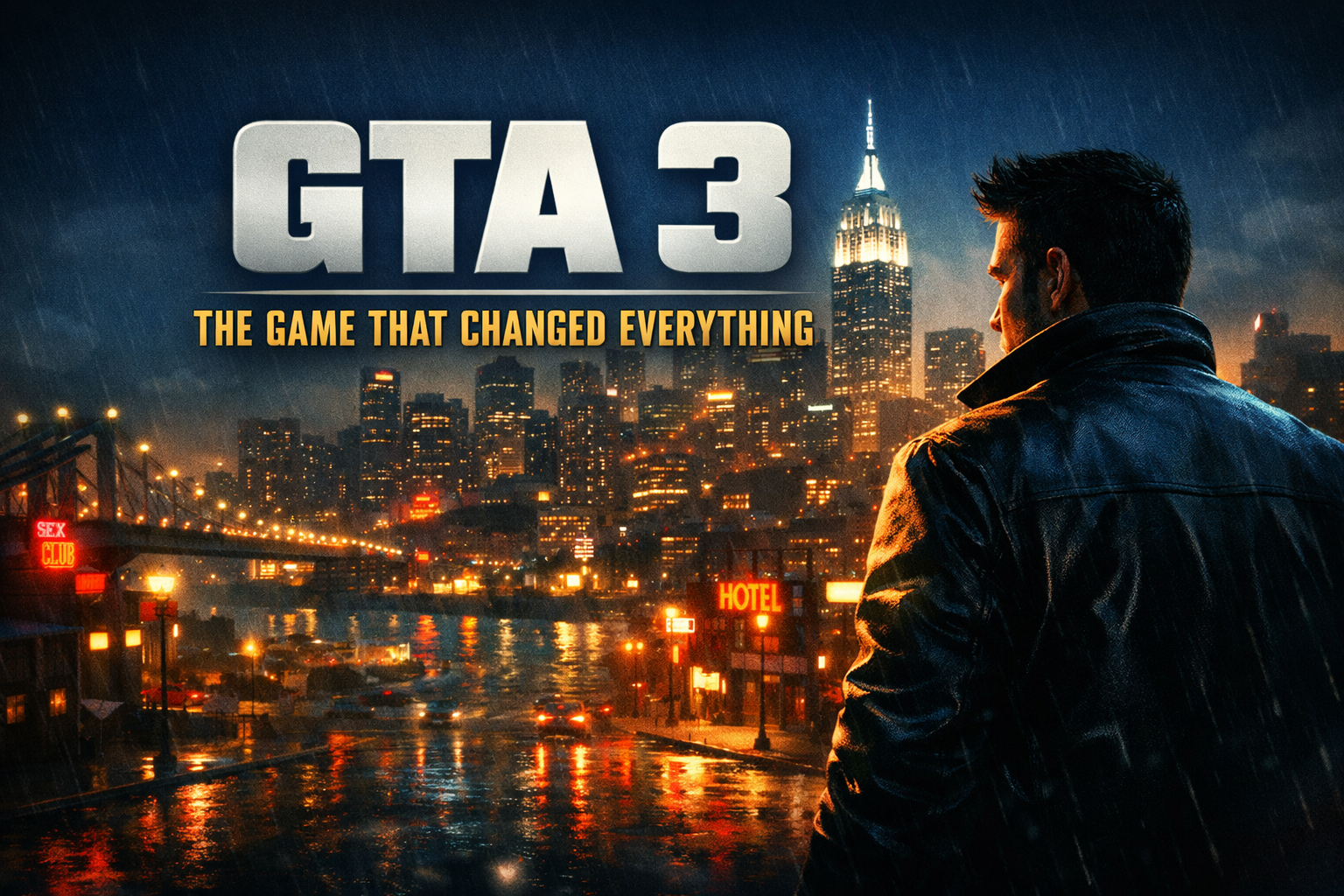
GTA 3: The Game That Changed Everything Forever
When Grand Theft Auto III launched in 2001, very few people realized they were witnessing a turning point in gaming history. At first glance, it looked like another crime-based action title, but within minutes of playing, it became clear that this was something entirely different. GTA 3 didn’t just improve on what came before—it rewrote the rules of what video games could be.
For the first time, players were dropped into a fully realized 3D city that didn’t feel like a level or a backdrop. Liberty City felt alive. It moved, reacted, and existed independently of the player. That single design decision changed the direction of the entire industry and laid the foundation for modern open-world games.
The Birth of the Modern Open World
Before GTA 3, open-world concepts existed, but they were limited by technology and design philosophy. Most games were structured around levels, corridors, or clearly defined paths. GTA 3 shattered that structure by giving players a city instead of a map.
Liberty City wasn’t just large—it was functional. Traffic followed patterns, pedestrians reacted to danger, and the world continued whether you followed the mission marker or ignored it completely. You could steal a car, drive for no reason at all, listen to the radio, or simply explore side streets and rooftops. This sense of freedom was unprecedented in 2001.
The city was divided into three main islands—Portland, Staunton Island, and Shoreside Vale—each with its own personality, visual style, and criminal ecosystem. Progressing through them felt like climbing the ranks of an underground world, reinforcing the idea that you were part of something bigger than individual missions.
A Silent Protagonist and Memorable Characters
Claude Speed, GTA 3’s protagonist, never speaks a single word. Instead of feeling empty, his silence gave players freedom to project themselves onto him. Claude became a vessel for the player’s choices, actions, and moral boundaries—or lack thereof.
Surrounding him was a cast of unforgettable characters. Mafia bosses, corrupt businessmen, unstable criminals, and chaotic personalities filled Liberty City with life. Characters like Salvatore Leone and Maria Latore weren’t just mission-givers; they were symbols of a city driven by greed, power, and betrayal.
Even radio hosts became iconic. Talk shows like Chatterbox FM provided satire that mocked media culture, politics, and social behavior. These voices made Liberty City feel like a real place with opinions, humor, and absurdity.
Gameplay Systems That Set New Standards
GTA 3 introduced gameplay mechanics that are now industry standards. The wanted level system created natural consequences for player actions. Cause chaos, and the police respond. Cause more chaos, and the city turns against you. This simple system added tension without forcing strict rules.
Vehicle variety was another breakthrough. Cars handled differently, crashed differently, and served different purposes. Driving wasn’t just transportation—it was gameplay. High-speed chases, narrow escapes, and reckless experimentation became core parts of the experience.
Mission design also respected player choice. While objectives were clear, the path to success was often flexible. Players could approach situations aggressively or cautiously, creatively or recklessly. That freedom encouraged experimentation and replayability.
Liberty City as a Living Character
Liberty City wasn’t just a setting—it was the soul of the game. Inspired by New York City, it captured the feeling of an urban environment filled with opportunity and danger. Industrial docks, financial districts, residential neighborhoods, and underground tunnels all worked together to create a believable world.
Environmental storytelling played a massive role. Graffiti revealed gang territories, architecture hinted at economic class, and subtle details suggested a history beyond the player’s actions. Exploring the city felt rewarding because it constantly told stories without words.
Vertical design added depth. Elevated highways, rooftops, bridges, and hidden paths made the city feel layered rather than flat. This approach to world-building influenced countless open-world games that followed.
Cultural Impact Beyond Gaming
GTA 3 wasn’t just successful—it was controversial. Its mature themes, violence, and unapologetic satire sparked debates across media outlets and political circles. Critics questioned its influence, while players embraced its honesty and freedom.
These controversies ultimately helped legitimize video games as a serious form of entertainment. GTA 3 proved that games could provoke discussion, challenge norms, and reflect society in ways similar to films or novels.
The soundtrack further expanded its cultural footprint. From hip-hop to talk radio satire, the audio experience made every drive memorable. Many players still remember specific radio segments more vividly than entire missions.
Technical Achievement Ahead of Its Time
Released on the PlayStation 2, GTA 3 pushed hardware far beyond expectations. A seamless open world with minimal loading was almost unheard of at the time. Rockstar achieved this through clever optimization, simplified geometry, and smart design compromises.
Lighting, weather effects, and day-night cycles added atmosphere and immersion. Audio design played an equally important role, with positional sound and layered ambient noise creating the illusion of a living city.
While the graphics may appear dated today, the ambition behind them remains impressive even by modern standards.
A Legacy That Still Shapes Gaming
The influence of GTA 3 is everywhere. Entire franchises and genres exist because it proved that open-world design could work on a massive scale. Games like Saints Row, Watch Dogs, Mafia, and even Rockstar’s own later titles all trace their DNA back to Liberty City.
More importantly, GTA 3 changed expectations. Players no longer wanted linear paths—they wanted worlds. Developers no longer built levels—they built cities.
Even today, design principles introduced in GTA 3 are taught, studied, and reused across the industry.
Why GTA 3 Still Matters Today
More than two decades later, GTA 3 remains relevant. Its mechanics may feel simple, but its design philosophy is timeless. Player freedom, systemic consequences, and immersive world-building are still goals modern developers struggle to perfect.
Remastered and definitive editions have introduced the game to new generations, ensuring its legacy continues. While technology evolves, the core ideas behind GTA 3 remain as powerful as ever.
Conclusion
GTA 3 didn’t just change gaming—it defined its future. It transformed open-world design, matured storytelling in video games, and proved that interactive worlds could rival any other form of entertainment.
Liberty City remains one of gaming’s greatest playgrounds because it trusts the player. It invites exploration, rewards curiosity, and allows chaos without judgment. That philosophy is why GTA 3 isn’t just remembered—it’s respected.
Few games can truly claim to have changed everything. GTA 3 is one of them.
FAQs
Q: What made GTA 3 revolutionary?
A: GTA 3 introduced a fully 3D open world with complete player freedom, dynamic systems, and immersive storytelling, setting the standard for modern open-world games.
Q: Is GTA 3 still worth playing today?
A: Yes. While its visuals are dated, its gameplay design, atmosphere, and influence still make it an enjoyable and important experience.
Q: How long does GTA 3 take to complete?
A: The main story takes around 15–20 hours, but completionists can spend 40+ hours exploring everything.
Q: Why was GTA 3 controversial?
A: Its violence, crime-focused narrative, and mature themes sparked debates about media influence and censorship.
Q: How did GTA 3 influence other games?
A: It created the blueprint for the modern open-world genre, influencing countless games across multiple platforms and generations.